


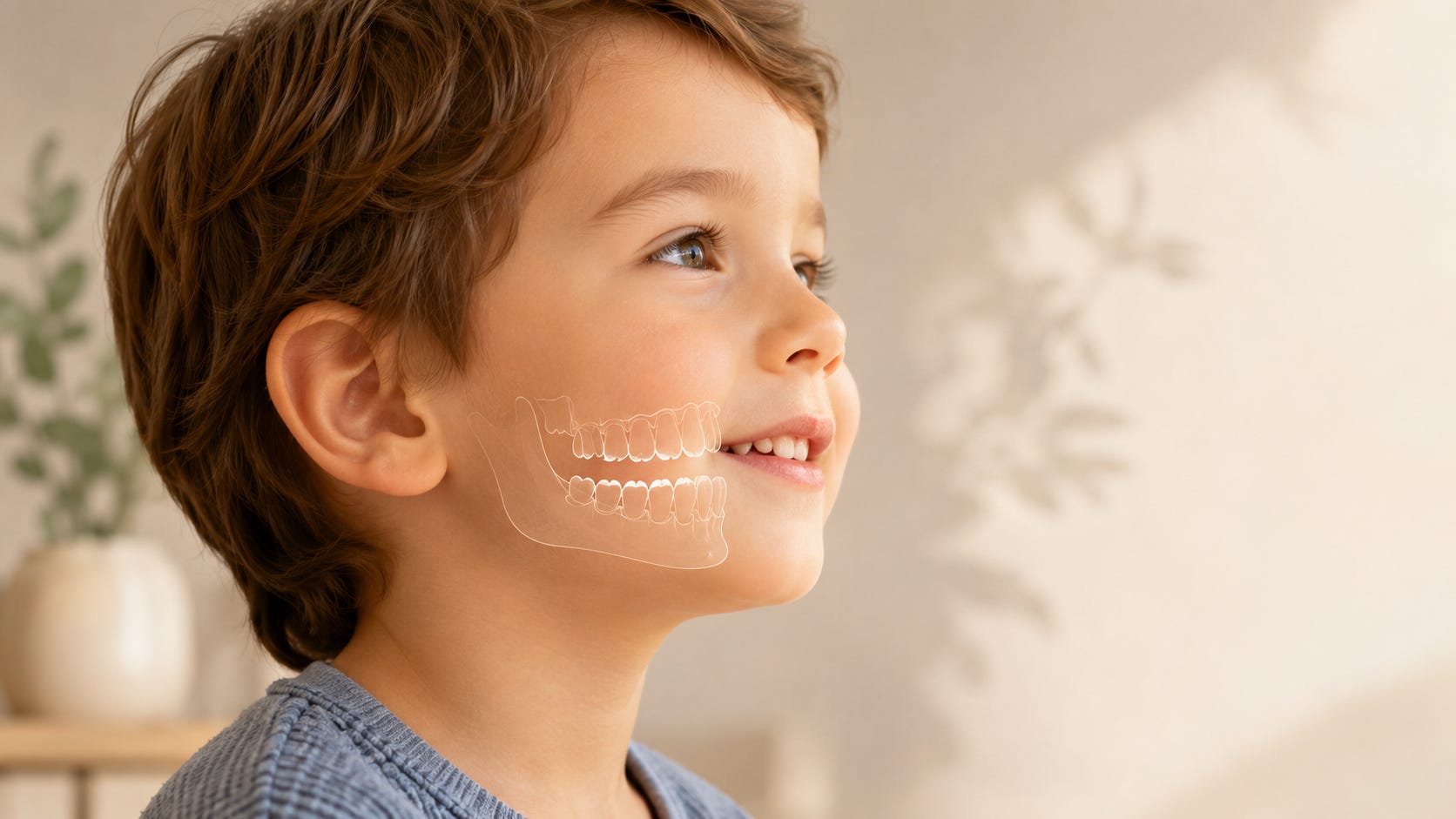
In the previous Johnson Paper, I asked how our airways became so small. We looked at the relationship between modern food, reduced chewing, tongue posture, jaw development, crowded teeth, nasal breathing, and sleep. For parents, however, there is another question that may be even more useful: How early can we begin to see the clues?
Most parents enter the orthodontic conversation when the permanent teeth begin to appear. An adult front tooth erupts behind a baby tooth. Two incisors overlap. A dentist points out a crossbite or explains that there may not be enough room for the remaining teeth. At that moment, the problem can feel as though it has suddenly arrived, but the visible crowding is often only the latest chapter in a developmental story that began years earlier.
Long before braces are discussed, the mouth is learning how to function. A baby is learning to latch, swallow, and breathe. The tongue is learning where to rest. The lips and cheeks are learning how to cooperate with the tongue and jaw. Later, the child begins handling different food textures, developing chewing patterns, and transitioning from an infant swallow toward a more mature way of eating.
The baby teeth then begin to provide us with visible information about how the arches are developing. Their spacing, alignment, bite relationship, and position within the jaws can offer clues about whether the mouth is creating room for the larger permanent teeth that will eventually replace them.
None of this should be read as an indictment of parents. Feeding does not always go according to plan. Breastfeeding may be difficult or impossible for reasons outside anyone’s control. Some babies are born prematurely or have medical complications. Some mothers struggle with milk supply, pain, or recovery after delivery. Some children have structural or neurological challenges that affect feeding. Genetics also remain an important part of facial and dental development.
The purpose of looking earlier is not to create guilt. It is to create opportunity. When we understand that oral development begins before the crooked teeth appear, we can become more observant about function, more thoughtful about growth, and more willing to investigate a pattern before it becomes a larger problem.
Breastfeeding Is More Than the Delivery of Milk
Breastfeeding is usually discussed in terms of nutrition and immunity, but it is also a complex physical activity. A nursing baby must coordinate the tongue, lips, cheeks, jaw, swallowing mechanism, and breathing pattern. The baby establishes a latch, creates negative pressure within the mouth, draws milk, swallows, and continues breathing without repeatedly losing the seal.
This is different from simply pouring nutrition into the mouth. The infant is performing coordinated muscular and neurological work.
When nursing is effective, the tongue moves broadly and rhythmically. The jaw participates. The lips maintain the seal, while the tongue and oral structures help create the pressure changes needed to transfer milk. This repeated activity gives the developing mouth an early functional pattern on which later chewing and swallowing can build.
The American Academy of Pediatrics recommends exclusive breastfeeding for approximately the first six months when possible, followed by continued breastfeeding as complementary foods are introduced. It supports continued breastfeeding for two years or beyond when mutually desired by the mother and child. The same guidance also emphasizes that conversations about breastfeeding should be nonjudgmental because exclusive breastfeeding is not possible for every family.
Research examining breastfeeding and later dental development has found associations between longer breastfeeding and lower rates of certain bite problems, particularly posterior crossbite. Those findings do not mean breastfeeding guarantees straight teeth, nor do they mean bottle-feeding causes malocclusion. They tell us that early feeding function may be one meaningful influence within a much larger developmental system.
That distinction matters. We should not turn a biological observation into a moral judgment. A mother who cannot breastfeed has not failed her child, and a child who is bottle-fed is not destined to have a narrow palate or airway problem. What we can say is that feeding is a functional event, and when feeding is not working well, the mechanics deserve attention rather than dismissal.
When Feeding Is Difficult, We Should Ask Why
Many parents know almost immediately when nursing is not going well. The baby may have trouble maintaining a latch, click or lose suction, tire quickly, feed for long periods without seeming satisfied, or repeatedly fall asleep before taking in enough milk. The mother may experience significant pain or tissue damage. Weight gain may become a concern.
Tongue restriction may be one reason for these difficulties, but it is not the only reason.
The increased awareness of tongue-ties has helped many families obtain evaluations that were not commonly available a generation ago. At the same time, a visible frenulum should not automatically be treated as proof that a procedure is necessary. The American Academy of Pediatrics distinguishes between a tongue that merely appears restricted and symptomatic ankyloglossia, in which restricted tongue movement is accompanied by breastfeeding difficulty that does not improve with skilled lactation support. Its clinical report notes that fewer than half of infants with physical findings consistent with a tongue-tie experience breastfeeding difficulty.
This is why I believe the evaluation should be functional. Can the baby elevate and move the tongue effectively? Can the baby maintain a latch? Is milk transfer adequate? Is the mother experiencing pain? Has someone who understands breastfeeding mechanics directly observed the feeding?
Those questions are more meaningful than simply looking beneath the tongue for a tight band of tissue.
When a restriction is truly interfering with function, a coordinated team may be helpful. Depending on the situation, that team may include the pediatrician, lactation consultant, feeding therapist, dentist, or ear-nose-and-throat physician. The objective should not be to perform a procedure because a structure looks unusual. The objective should be to understand why feeding is difficult and support the baby’s ability to function.
Weaning Is a Developmental Transition
Eventually, a child begins moving beyond an exclusively milk-based diet and exploring complementary foods. We often think of this transition only in nutritional terms: when to add iron, protein, vegetables, fruits, and other foods. From an oral-development perspective, however, weaning is also a transition in movement, sensation, posture, and coordination.
A child begins learning that food can have texture. The hands bring food toward the mouth. The lips examine it. The tongue moves it. The gums and emerging teeth begin to press, mash, and eventually chew. The child learns how much food can be managed at one time and how to move it safely toward the back of the mouth.
I have become interested in baby-led weaning because it encourages parents to pay attention to developmental readiness rather than treating feeding as something done entirely to the child. The child is given an opportunity to touch, smell, taste, and safely explore food while gradually developing the motor skills needed for self-feeding.
I do not believe this requires a rigid allegiance to one feeding philosophy. Purées are not inherently harmful, and there are times when spoon-feeding is appropriate, practical, and nutritionally valuable. The greater concern is rushing a child into a texture before the child is ready or, at the other extreme, keeping a child on an unnecessarily narrow range of soft textures long after the oral system is capable of doing more.
Most babies begin showing readiness for complementary foods at approximately six months, although development varies. The child should be able to sit with appropriate support, maintain head control, bring objects toward the mouth, and manage soft food safely. Current pediatric guidance also cautions that the evidence for specific health advantages of baby-led weaning remains limited. The value of the approach may lie less in following a strict program and more in observing the child’s readiness, offering appropriate variety, and allowing safe participation in eating.
Safety is essential. A baby should be upright and supervised, and foods should be soft enough to mash with the gums or a few teeth. Round, hard, sticky, or coin-shaped foods can obstruct the airway and must be avoided or modified. A whole raw carrot, a chunk of meat, a whole grape, a nut, or a spoonful of thick nut butter is not an oral-development exercise for an infant. It is a choking hazard. Pediatric guidance specifically warns parents not to assume that every image of a baby holding a large piece of food represents a safe feeding practice.
Parents also need to understand that gagging and choking are not the same event. Gagging can occur as a child learns to manage texture and may serve as a protective response, but choking can be silent and life-threatening. Families beginning complementary feeding should understand safe food preparation, know the signs of choking, and discuss concerns with their pediatrician or feeding professional.
The deeper principle is that weaning should follow development. We do not want to push the oral system beyond what it can safely manage, but neither do we want to prevent it from learning the work it is ready to perform.
The Developing Mouth Needs Appropriate Work
Modern food has made eating remarkably easy. Children can consume a large portion of their calories through pouches, drinks, soft breads, crackers that dissolve in the mouth, mashed foods, processed snacks, gummies, and meals that require very little chewing.
Convenience is not always bad. A pouch may be useful during travel, and a soft meal may be appropriate for a young child or someone recovering from illness. The question is whether convenience has gradually become the entire diet.
The muscles and bones of the face are living tissues that respond to function. Chewing requires coordination of the jaw muscles, tongue, cheeks, teeth, and sensory system. Children develop more efficient chewing patterns as they encounter foods with different structural properties and textures. Experimental research, much of it conducted in animals, also suggests that prolonged soft diets can affect jaw-bone metabolism and craniofacial development. Human evidence is less complete, so we should not claim that one food texture determines the size of a child’s jaws. The available evidence does, however, support taking masticatory function seriously.
I am not suggesting that parents hand an infant a strip of jerky or ask a toddler to chew something unsafe. Age and developmental readiness matter. What I am asking is whether a growing child who receives nearly all calories in soft or highly processed forms is giving the chewing system the same variety of work it would receive from a broader whole-food diet.
As children become capable, they can gradually encounter vegetables prepared to an appropriate firmness, fruits with texture, meats that require controlled chewing, and other whole foods suited to their age. The objective is not to make eating difficult for the sake of difficulty. It is to let eating remain a physical function rather than reducing it entirely to the passive delivery of calories.
This principle continues beyond infancy. The jaws, muscles, and oral habits are still developing through childhood and adolescence. A teenager who drinks breakfast, eats a soft sandwich at lunch, snacks on gummies, and finishes the day with another highly processed meal may rarely ask the masticatory system to do much work.
The modern mouth may receive plenty of calories while receiving very little challenge.
The Tongue Is Part of the Growth System
The tongue is one of the most influential structures in the developing mouth, yet its resting position is rarely discussed with parents. Most people think about the tongue when a child is speaking, swallowing, or tasting food. The rest of the time, the tongue seems inactive, but it is always resting somewhere.
That resting place matters because teeth erupt into a muscular environment. The tongue exerts pressure from inside the dental arches, while the lips and cheeks exert pressure from outside. When those forces are reasonably balanced, they help create a stable environment for tooth position.
The American Academy of Pediatric Dentistry notes that the resting pressures of the lips, cheeks, and tongue have more influence on tooth position than the brief forces produced during an individual swallow. It also distinguishes between a visible tongue-thrust swallow and a persistently forward resting posture. An intermittent movement during swallowing may have limited importance when the resting posture is normal, while an abnormal resting position can contribute to displacement of the teeth.
This is an important refinement. We should not blame every crooked tooth on one imperfect swallow, nor should we assume that a child must consciously press the tongue against the palate throughout the day. Oral function is more complex than a single exercise or instruction.
What we should notice is the pattern. Does the tongue appear to live low in the mouth? Does it move forward between the teeth when the child swallows? Do the lips strain to create a seal? Is the mouth habitually open? Is the child able to breathe comfortably through the nose? Is tongue mobility restricted? Is there a crossbite, open bite, or narrow upper arch?
Research supports a relationship between tongue posture, oral muscular balance, and dental-arch development, although these factors are associational and do not explain every case of crowding or malocclusion. Genetics, tooth size, nasal obstruction, prolonged sucking habits, premature tooth loss, skeletal growth patterns, and other influences also matter.
The tongue should therefore be evaluated as part of a system rather than treated as the answer to every problem.
The Roof of the Mouth Is Also the Floor of the Nose
One reason tongue posture matters so much in airway dentistry is anatomical. The upper jaw, or maxilla, forms the dental arch and palate, but that same bone also contributes to the floor and sidewalls of the nasal cavity.
The mouth and nose are not two unrelated compartments. They share a developmental foundation.
When the upper arch is narrow, the palate often appears high and constricted. When nasal breathing is difficult, the child may open the mouth and lower the tongue as a compensation. That lower oral posture may then alter the muscular environment surrounding the teeth and jaws. Over time, breathing, posture, dental development, and facial growth may influence one another.
Studies examining chronic mouth breathing have found associations with narrower maxillary development, altered mandibular posture, increased vertical facial growth, and certain forms of malocclusion. The direction of cause is not always simple. Nasal obstruction can lead to mouth breathing and changed posture, while craniofacial anatomy can also make the airway less favorable.
This is why telling a child to close the mouth is often inadequate. A child who habitually mouth-breathes may be compensating for congestion, enlarged tonsils or adenoids, allergies, a restricted nasal passage, or another airway problem. The child may not be choosing a habit that can be corrected by reminders.
The first question should be whether nasal breathing is comfortable and sustainable.
Why Spaces Between Baby Teeth Matter
Parents naturally admire a row of perfectly straight baby teeth. When the teeth sit tightly together without gaps, the smile may look especially neat. From a developmental perspective, however, I often find spacing more reassuring.
Permanent teeth are generally larger than the baby teeth they replace. The arches must therefore provide additional room as the child moves from the primary dentition into the mixed and permanent dentitions. Some of that room comes from normal spacing between the baby teeth, along with changes in the dental arches as the child grows.
This does not mean every child needs a specific measured gap between every tooth. I sometimes use a simple visual description with parents and tell them I like to see generous breathing room in the primary dentition, but the mouth cannot be diagnosed with a home measurement or a photograph alone.
Spacing is also not a guarantee. A child with spaces between the baby teeth may still develop crowding, and a child with tightly arranged baby teeth may not experience severe malalignment. Tooth size, arch length, eruption sequence, skeletal relationships, early tooth loss, and many other factors affect the final result.
Even with those qualifications, the absence of primary-tooth spacing can be an important clue. Longitudinal and observational research has found that features of the primary dentition can help predict later occlusal patterns and that a lack of available space increases the risk of crowding as the larger permanent teeth emerge.
The tightly arranged baby smile may be beautiful, but it may also be telling us that the permanent teeth will have little reserve space.
That does not mean treatment must begin immediately. It means the child’s development should be watched thoughtfully.
A Crossbite Is More Than a Crooked Tooth
A crossbite occurs when one or more upper teeth sit inside the corresponding lower teeth rather than outside them. It may involve the front teeth, one side of the back teeth, or both sides. A crossbite can arise from tooth position, skeletal development, a functional shift of the jaw, or a combination of these factors.
To a parent, it may look like a small alignment problem. To a dentist or orthodontist, it may be evidence that the upper and lower arches are not developing in a balanced relationship.
The American Academy of Pediatric Dentistry recommends that evaluations during the primary dentition include attention to anterior and posterior crossbites, oral habits, and airway concerns. It also notes that treatment can benefit many children but is not indicated for every developing malocclusion. Decisions require an understanding of craniofacial growth, the child’s bite, the type of crossbite, the available space, and the broader treatment needs.
This is the kind of measured early attention I want parents to understand. An early evaluation does not mean every child needs an expander. It does not mean an appliance should be placed simply because the palate appears narrow. Expansion is not a universal answer, and an appliance should never substitute for a complete diagnosis.
Sometimes the correct decision is to monitor. Sometimes a nasal or tonsillar issue needs medical attention. Sometimes a habit is contributing. Sometimes myofunctional support is appropriate. Sometimes orthodontic intervention is beneficial, particularly when a functional shift or adverse growth pattern is developing.
The value of looking early is that the full range of options is still available.
Snoring and Mouth Breathing Should Not Be Ignored
Parents are often told that children snore because they are tired, congested, or sleeping deeply. Occasional snoring during a cold is different from persistent loud snoring when a child is otherwise healthy.
Regular snoring, chronic mouth breathing, witnessed pauses in breathing, restless sleep, unusual sleeping positions, morning headaches, difficulty waking, daytime sleepiness, attention problems, and behavioral changes can be signs that a child’s breathing during sleep deserves evaluation. The American Academy of Pediatric Dentistry’s current policy encourages dental professionals to screen for these signs and refer children who may be at risk to an appropriate medical provider.
The most common causes of pediatric obstructive sleep apnea are not simply narrow dental arches. Enlarged tonsils and adenoids are major contributors in otherwise healthy children, while obesity, craniofacial differences, neuromuscular conditions, and other anatomical or physiological factors may also play a role. Pediatric sleep-disordered breathing is multifactorial, and a dentist cannot diagnose it by looking at the teeth alone.
When sleep apnea is suspected, the child may need evaluation by a pediatrician, ear-nose-and-throat physician, pulmonologist, or sleep-medicine specialist. Polysomnography, or an overnight sleep study, remains the medical standard used to confirm or rule out obstructive sleep apnea in a symptomatic child.
Dentistry still has an important role. The dentist may be the first professional to notice a high narrow palate, crossbite, enlarged tonsils, open-mouth posture, unusual tongue position, worn teeth, or a parent’s report of snoring. Those findings should not be used to sell a predetermined appliance. They should be used to ask better questions and, when necessary, bring the appropriate professionals into the conversation.
Early Clues Are Not Early Diagnoses
The central idea of this article is not that parents should inspect every movement of the tongue or become anxious about every tightly arranged baby tooth. A developing child will change constantly. Feeding will not be perfect. Colds will temporarily affect nasal breathing. Children will move through awkward stages as teeth erupt and oral patterns mature.
We are looking for persistent patterns rather than isolated moments.
A child who repeatedly struggles to latch or transfer milk may need a feeding evaluation. A child who cannot progress through safe food textures may need pediatric or feeding support. A child whose mouth remains open throughout the day may need an airway evaluation. A crossbite, a very narrow arch, a low resting tongue, or a primary dentition with little available space may justify closer dental or orthodontic observation. Regular snoring when the child is healthy should be discussed with a medical provider.
None of those findings proves that a child has sleep apnea, requires a tongue release, needs myofunctional therapy, or should begin orthodontic expansion. They indicate that the function and development of the entire system deserve attention.
This is what biological and airway-focused dentistry can add to the traditional dental examination. We still look for cavities, enamel problems, gum health, eruption, and bite relationships, but we also ask how the child is breathing, sleeping, chewing, swallowing, and using the tongue.
We look at the teeth, but we do not stop at the teeth.
Before the Crooked Teeth
By the time permanent teeth begin erupting into a crowded arch, much of the early developmental story has already been written. The child has spent years breathing through the nose or mouth, using the tongue in a particular resting position, developing a swallowing pattern, and eating foods that required either more or less chewing.
The baby teeth may have been offering clues during that entire period.
They may have shown generous spacing or none at all. The upper arch may have developed broadly, or a crossbite may have appeared. The child may have slept quietly with the lips together, or the parents may have noticed snoring, restlessness, congestion, or an open mouth.
No single clue tells us everything. Development is an interaction among genetics, anatomy, breathing, feeding, muscles, habits, health, and environment. It would be irresponsible to reduce that complexity to one cause or one treatment.
It would be equally irresponsible to pretend the clues do not matter.
Parents do not need to become experts in orthodontics or sleep medicine. They simply need to know that oral development begins earlier than most people realize and that the mouth is connected to feeding, breathing, sleep, and facial growth from the beginning.
When we notice a pattern early, the first step is not always treatment. Often, the first step is a better question.
Can this child breathe comfortably through the nose? Is feeding effective? Is the tongue able to move and rest appropriately? Are the dental arches creating room for the teeth that are coming? Is the child sleeping quietly and waking rested? Does the bite suggest that the upper and lower jaws are developing in harmony?
Those questions allow us to move beyond waiting for crooked teeth and then attempting to arrange them within whatever space happens to be available.
They allow us to think about how the space developed in the first place.
That is the opportunity hidden within the baby teeth. They are temporary, but the developmental information they provide may be far more important than we once understood.
Dr. John Johnson, DDS
Midwest BioHealth
The Johnson Papers
Meek JY, Noble L; Section on Breastfeeding. Policy Statement: Breastfeeding and the Use of Human Milk. Pediatrics. 2022;150(1):e2022057988.
Sakalidis VS, Geddes DT. Suck-Swallow-Breathe Dynamics in Breastfed Infants. Journal of Human Lactation. 2016;32(2):201–211.
Thomas J, Bunik M, Holmes A, et al. Identification and Management of Ankyloglossia and Its Effect on Breastfeeding in Infants: Clinical Report. Pediatrics. 2024;154(2):e2024067605.
Peres KG, Cascaes AM, Nascimento GG, Victora CG. Effect of breastfeeding on malocclusions: a systematic review and meta-analysis. Acta Paediatrica. 2015;104(S467):54–61.
Abate A, Cavagnetto D, Fama A, Maspero C, Farronato G. Relationship between Breastfeeding and Malocclusion: A Systematic Review of the Literature. Nutrients. 2020;12(12):3688.
Agbim IA, Waasdorp Hurtado C. Baby-Led Weaning: Is It Safe? HealthyChildren.org. Updated December 3, 2024.
Simione M, et al. Differing structural properties of foods affect the development of mandibular control and muscle coordination in infants and young children. Physiology & Behavior. 2018;186:62–72.
Fujita Y, Maki K. Association of feeding behavior with jaw bone metabolism and tongue pressure. Japanese Dental Science Review. 2018;54(4):174–182.
American Academy of Pediatric Dentistry. Management of the Developing Dentition and Occlusion in Pediatric Dentistry. The Reference Manual of Pediatric Dentistry. Chicago, Ill.: American Academy of Pediatric Dentistry; 2025:497–515.
Lin L, Zhao T, Qin D, Hua F, He H. The impact of mouth breathing on dentofacial development: A concise review. Frontiers in Public Health. 2022;10:929165.
Foster TD, Grundy MC. Occlusal changes from primary to permanent dentitions. British Journal of Orthodontics. 1986;13(4):187–193.
American Academy of Pediatric Dentistry. Policy on Obstructive Sleep Apnea. Latest revision 2026. The Reference Manual of Pediatric Dentistry.