


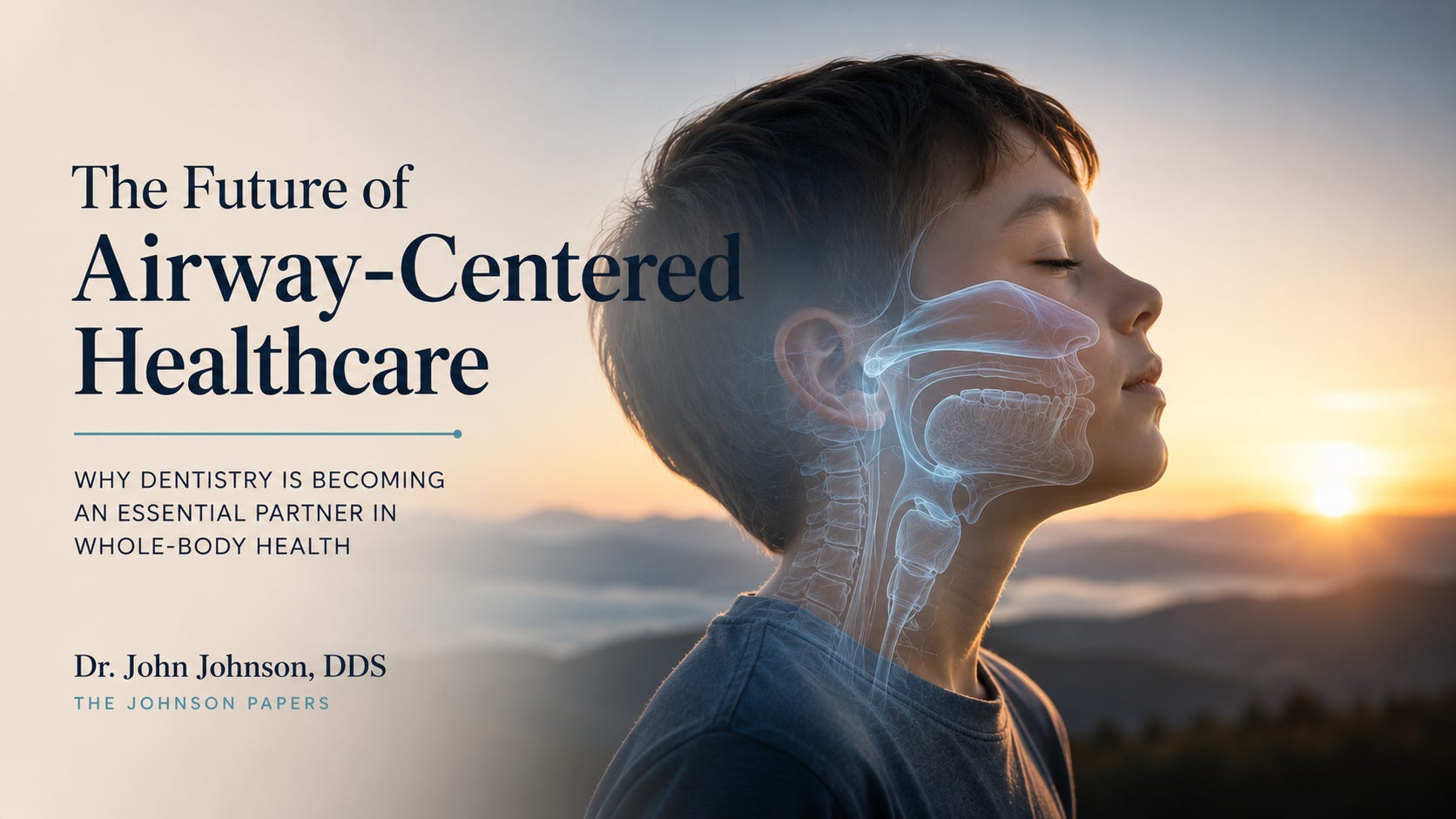
As our understanding of human physiology continues to deepen, the traditional separation between medicine and dentistry appears increasingly artificial. The body does not organize itself according to professional boundaries. Every system influences another, and few structures demonstrate this more clearly than the airway. It is far more than a passage through which air travels. The airway connects breathing, sleep quality, craniofacial development, cardiovascular regulation, metabolic health, neurological function, and overall vitality.
During much of my professional career, dentistry and medicine largely advanced along parallel paths. Physicians focused on the heart, lungs, brain, endocrine system, and internal organs. Dentists concentrated on the teeth, supporting bone, and oral tissues. Orthodontists aligned teeth and jaws, sleep physicians diagnosed obstructive sleep apnea, and otolaryngologists managed diseases of the ear, nose, and throat. Each specialty developed extraordinary expertise within its own field, and patients benefited greatly from that specialization.
Yet the body has never functioned according to these divisions. Every physiological process overlaps with another. A disturbance in one system often produces consequences elsewhere. As clinicians, we are increasingly recognizing that many of the conditions we once viewed in isolation are, in reality, interconnected expressions of a much larger biological picture.
The airway is one of the clearest examples of this integration.
For many years, dentistry was largely restorative in nature. When a tooth fractured, we repaired it. When decay developed, we removed it and restored the tooth. If a patient developed periodontal disease, we treated the infection and stabilized the supporting tissues. Orthodontics corrected malocclusion, and prosthetic dentistry replaced missing teeth. These remain essential aspects of comprehensive care, and they always will.
What has changed is not the importance of restoration, but the questions we ask before treatment begins.
Over the years, I have found myself becoming increasingly interested in understanding why problems develop in the first place. Why do some patients experience accelerated tooth wear while others of the same age do not? Why does one individual develop significant bite instability while another maintains a remarkably stable occlusion throughout life? Why do some patients grind their teeth during sleep despite otherwise healthy dentition? What role might breathing, airway anatomy, sleep quality, or craniofacial development play in shaping these outcomes?
These are not simply academic questions. They fundamentally change how we view patient care.
Rather than treating the visible consequences alone, we begin looking for the underlying physiological processes that produced them. In doing so, dentistry becomes less about repairing isolated structures and more about understanding the patient as an integrated biological system.
This shift has transformed the way many of us think about the mouth itself.
It has long been convenient to consider the oral cavity as a relatively self-contained region of the body. Clinical experience and an expanding body of scientific literature continue to demonstrate otherwise. Every breath passes through the oral and pharyngeal spaces. Nutrition begins there. Speech, swallowing, facial growth, airway maintenance, and neuromuscular function all depend upon structures that dentists evaluate every day.
Likewise, systemic health continually influences the mouth. Inflammation, endocrine function, nutrition, immune regulation, hormonal balance, metabolic disease, and sleep quality all affect oral tissues and healing capacity. The relationship is not new. Our understanding of that relationship continues to mature.
Among all of these connections, airway health has become one of the most important catalysts for changing how we think about dentistry.
For many years, obstructive sleep apnea was viewed primarily as a disorder of snoring and excessive daytime fatigue. Today, we recognize that disrupted breathing during sleep may influence cardiovascular regulation, glucose metabolism, cognitive performance, emotional health, inflammatory pathways, and overall quality of life. This expanding understanding has naturally raised another important question.
Who is in a position to recognize the earliest signs?
Interestingly, many of the anatomical features associated with airway dysfunction are structures dentists evaluate routinely. The resting posture of the tongue, the width and contour of the palate, jaw relationships, characteristic wear patterns on the teeth, facial proportions, bite stability, and oral habits all provide valuable clinical information. None of these observations replaces the diagnostic expertise of a sleep physician. They do, however, create opportunities for earlier recognition.
Patients often see their dentist more consistently than they see any other healthcare provider. They may visit every six months for years while subtle developmental or functional changes gradually become apparent. Sometimes those changes involve worn teeth. Sometimes they involve narrowing of the dental arches, chronic mouth breathing, or alterations in facial growth. Individually, these findings may appear unrelated. Viewed together, they often tell a much more comprehensive story.
This is where dentistry has an opportunity to contribute in ways that extend well beyond the restoration of teeth.
Research continues to strengthen these observations. Investigators have identified meaningful associations between obstructive sleep apnea and conditions such as bruxism, xerostomia, temporomandibular disorders, and periodontal disease. Pediatric studies have demonstrated how chronic mouth breathing and persistent nasal obstruction may influence craniofacial development during critical periods of growth. These developmental patterns can reduce the space available for the tongue and airway, increasing the likelihood of breathing disturbances later in life.
Perhaps most encouraging is the realization that early recognition creates opportunities for early intervention.
This naturally leads to another important evolution in healthcare.
No single profession owns airway health.
Nor should it.
The most successful patient outcomes increasingly emerge from collaboration rather than isolation. Dentists, primary care physicians, sleep specialists, pediatricians, orthodontists, otolaryngologists, myofunctional therapists, physical therapists, nutrition professionals, and other healthcare providers each contribute unique expertise. Together, these perspectives allow us to understand not only what disease is present but why it developed.
This collaborative approach represents one of the most promising directions in modern healthcare. Rather than treating isolated symptoms through sequential referrals, clinicians are beginning to work together to identify contributing factors earlier and develop coordinated treatment strategies that address the patient as a whole.
Equally important is the opportunity to move our attention upstream.
The greatest advances in healthcare rarely come from treating advanced disease more effectively. They come from recognizing risk before disease becomes established.
In children, this may involve identifying chronic mouth breathing, noisy sleep, restless sleep patterns, persistent nasal obstruction, or altered facial growth while development is still occurring. In adults, it may involve recognizing characteristic wear patterns, changes in occlusion, or anatomical findings that suggest airway compromise long before severe symptoms develop.
This is prevention in its truest sense.
Not preventing a single disease, but supporting the normal physiology upon which long-term health depends.
Technology will undoubtedly accelerate this transformation. Artificial intelligence, wearable monitoring devices, home sleep testing, three-dimensional airway imaging, and increasingly sophisticated diagnostic tools will continue to improve our ability to recognize patterns and personalize treatment. These innovations are exciting and hold tremendous promise for the future.
At the same time, technology should never replace thoughtful clinical judgment.
Algorithms identify patterns. Experienced clinicians interpret meaning.
The future belongs not to technology alone, but to practitioners who combine technological advances with careful observation, attentive listening, and a deep understanding of human biology.
Throughout this series of Johnson Papers, we have explored airway health from multiple perspectives. We have examined the systemic consequences of sleep-disordered breathing, the emerging science of personalized airway medicine, advances in diagnostic technology, the importance of childhood development, and the early signs parents and clinicians should recognize.
Taken together, these discussions point toward something much larger than airway medicine alone.
They reflect an evolving philosophy of healthcare.
We are gradually moving away from viewing diseases as isolated problems requiring isolated solutions. Instead, we are learning to appreciate the remarkable interconnectedness of the human body. Dentistry is becoming an increasingly important part of that conversation, not because it seeks to replace medicine, but because it offers a unique perspective on structures and functions that influence overall health.
The dentist of the future will continue restoring teeth, preserving oral health, and improving smiles. Increasingly, however, that same dentist may also recognize patterns that influence breathing, sleep, growth, development, and long-term wellness. That broader perspective benefits not only dentistry but every profession committed to improving patient health.
The airway is not the answer to every clinical question.
Neither is it merely another anatomical structure.
It is the pathway through which every breath sustains life. It links sleep to recovery, recovery to healing, healing to development, and development to lifelong health.
As medicine and dentistry continue to evolve together, I believe one of our greatest opportunities lies not simply in developing more sophisticated treatments, but in recognizing the earliest signs of dysfunction before disease has the opportunity to become firmly established.
The future of healthcare will not belong to a single specialty.
It will belong to clinicians willing to recognize the connections that have always existed.
For many patients, those connections begin with something as fundamental—and as essential—as a healthy, well-functioning airway.
References
Maniaci A, et al. Oral Health Implications of Obstructive Sleep Apnea. Journal of Clinical Medicine. 2024. Available at: https://pmc.ncbi.nlm.nih.gov/articles/PMC11274061/
Gianoni-Capenakas S. Sleep-Disordered Breathing: The Dentists’ Role. Journal of Dental Sleep Medicine. 2020.
Cioboata R, et al. A Narrative Review of Sleep Apnea and Oral Health. Journal of Clinical Medicine. 2025.
Biscuola MPC, et al. Mouth Breathing and Obstructive Sleep Apnea in Children. International Journal of Oral and Maxillofacial Surgery (MDPI). 2025.
Izu SC, et al. Obstructive sleep apnea syndrome (OSAS) in mouth breathing children. Brazilian Journal of Otorhinolaryngology (PMC). 2015.
Dr. John Johnson, DDS
Midwest BioHealth
The Johnson Papers