


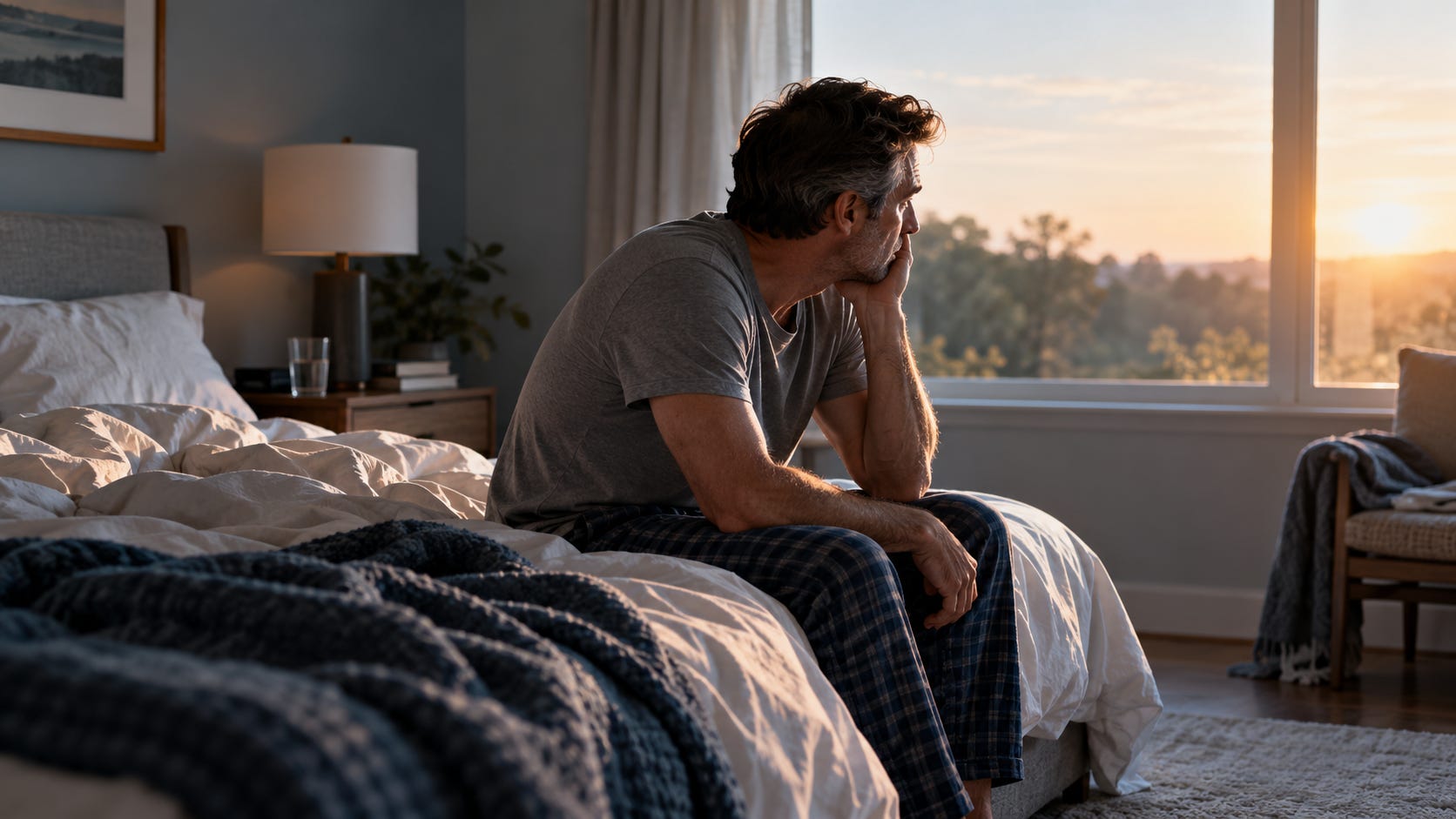
Eight hours has become something of a cultural benchmark for healthy sleep. We see it in medical recommendations, wellness articles, smartphone applications, and the growing collection of devices designed to measure how well we rest. For many people, getting eight hours feels like an accomplishment, particularly when work, family responsibilities, and the demands of daily life make sufficient sleep difficult to come by.
Yet there is a familiar frustration among people who appear to be doing everything correctly. They go to bed at a reasonable hour, sleep through most of the night, and wake up feeling as though they have accomplished very little resting at all. The alarm sounds, their eyes open, and instead of feeling restored, they begin another day already tired.
Some reach for coffee and gradually come to life. Others struggle with concentration, experience headaches, or find themselves fighting fatigue throughout the afternoon. They may blame stress, aging, their workload, or simply assume that feeling tired is part of being an adult.
What makes the experience particularly confusing is that, by the most familiar measurement, they have done what they were supposed to do. They went to bed. They slept. They allowed enough time.
So why doesn’t it feel like enough?
The answer begins with an important distinction that is often overlooked in conversations about sleep: the amount of time we spend in bed is not necessarily the same as the amount of restorative sleep we receive.
What Happens After We Close Our Eyes
Sleep is not a single, uniform state of unconsciousness. Throughout the night, the brain moves through different stages of sleep, each associated with distinct patterns of neurological and physiological activity. These stages include lighter non-rapid eye movement sleep, deeper slow-wave sleep, and rapid eye movement sleep, commonly known as REM sleep.
The normal progression through these stages is part of what allows sleep to support memory, learning, emotional regulation, and physical restoration. Deep sleep is associated with important restorative processes, while REM sleep contributes to memory and emotional processing. Both are components of a healthy night’s rest, and their timing and distribution change as the night progresses.
This is why sleep continuity matters.
A person may remain in bed for eight hours without experiencing eight hours of uninterrupted sleep. Brief awakenings can occur throughout the night, and some are entirely normal. Others may be frequent enough to fragment sleep and interfere with its restorative functions, even when the individual has little or no memory of waking.
The distinction is particularly important because we tend to judge sleep by what we remember. If we closed our eyes at ten o’clock and opened them at six, we may reasonably assume that we slept well. We might even report sleeping through the night.
But the brain may have experienced something quite different.
Sleep expert Nancy Rothstein has emphasized the importance of looking beyond the familiar measurements of sleep and paying closer attention to the sleeper. During a presentation to the American Academy of Physiological Medicine and Dentistry, she encouraged clinicians and patients to consider not only how long someone sleeps, but also how they feel upon waking and throughout the following day.
It is a useful change in perspective because restorative sleep is ultimately about more than accumulating hours. It is about allowing the body to move through the biological processes that make those hours valuable.
When Breathing Interrupts the Night
Among the conditions capable of disrupting sleep, breathing disorders deserve particular attention because they can occur without the sleeper fully recognizing what is happening.
During normal sleep, muscles throughout the body relax, including those involved in maintaining the openness of the upper airway. In some individuals, anatomical characteristics and changes in muscle activity allow the airway to become unusually narrow or collapse. Airflow may be reduced or temporarily interrupted, creating disturbances that can interfere with normal sleep.
Obstructive sleep apnea is one of the best-known examples.
When breathing becomes sufficiently restricted, the body may respond with changes in respiratory effort, oxygen levels, and brief arousals from sleep. These responses can help restore airflow, but repeated events may fragment the night’s sleep and contribute to significant daytime symptoms.
Not every person with obstructive sleep apnea experiences obvious gasping or remembers waking repeatedly. Some people become aware of the problem only because a bed partner notices loud snoring, pauses in breathing, or unusual breathing patterns during the night. Others seek evaluation because of persistent fatigue, morning headaches, difficulty concentrating, or sleep that never seems refreshing.
Snoring itself deserves some clarification. Although it is common and does not automatically indicate sleep apnea, it can be a sign of increased resistance to airflow through the upper airway. Persistent or disruptive snoring, particularly when accompanied by other symptoms, should not be dismissed as merely an inconvenience.
There are also sleep-related breathing disturbances that may produce arousals without the dramatic oxygen changes commonly associated with more severe obstructive sleep apnea. These patterns require appropriate evaluation because the relationship between breathing, sleep fragmentation, and daytime symptoms is more complicated than a single measurement can describe.
For patients, the important point is not to diagnose themselves based on a collection of symptoms. It is to recognize that breathing can interfere with sleep in ways that are not always obvious.
Someone may believe they are sleeping through the night while their body is repeatedly working to maintain an open airway.
What the Mouth May Reveal
For many people, the possibility that their dentist might identify clues related to sleep comes as a surprise. Dentistry is still commonly understood as the profession responsible for teeth, gums, cavities, and the maintenance of oral health.
But the mouth is also part of the respiratory system, and its surrounding structures contribute to the anatomy of the upper airway.
The position and development of the jaws, the shape of the palate, the available space for the tongue, and the relationship among oral and facial structures can all be relevant when considering breathing and sleep. These features do not independently determine whether someone has a sleep disorder, but they can contribute to a more complete understanding of a patient’s anatomy.
An airway-focused dental examination may also identify findings that prompt additional questions. Tooth wear, evidence of grinding or clenching, scalloping along the edges of the tongue, and reports of chronic dry mouth may be worth discussing in the context of other symptoms.
These findings must be interpreted carefully. Tooth grinding has multiple possible causes and does not establish the presence of sleep apnea. A scalloped tongue is not a diagnostic test for airway obstruction, and dry mouth can result from medications, dehydration, salivary conditions, and other factors unrelated to sleep-disordered breathing.
Their value lies in the broader clinical picture.
When a patient reports persistent fatigue, morning headaches, disruptive snoring, or unrefreshing sleep, oral findings may provide additional reasons to explore whether breathing deserves closer attention. A dentist trained in recognizing sleep-related concerns can screen for potential problems and coordinate with qualified medical professionals when further testing is indicated.
This collaborative approach is central to responsible airway-focused dentistry. Dentists may identify risk factors and, when appropriately trained and working within their scope of practice, participate in treatment. The diagnosis of obstructive sleep apnea, however, requires a medical sleep evaluation rather than conclusions drawn from oral anatomy alone.
The goal is not to turn every dental appointment into a sleep study. It is to recognize that oral health, breathing, and sleep are connected closely enough that important questions should not go unasked.
Why Better Sleep Habits May Not Be the Answer
In the first two articles of this series, we explored the importance of respecting the body’s natural sleep processes and creating an environment that supports them. Consistent schedules, reduced evening stimulation, appropriate light exposure, and a quieter transition toward bedtime can all contribute to healthier sleep.
Those habits remain important, but they have limits.
A comfortable bedroom cannot prevent every breathing disturbance. Avoiding screens before bed does not necessarily resolve obstructive sleep apnea. A carefully planned bedtime routine may help someone fall asleep more easily while doing little to address a physiological problem that repeatedly interrupts breathing after sleep begins.
This is where patients can become understandably discouraged.
They may spend months experimenting with supplements, mattresses, pillows, breathing exercises, relaxation techniques, and sleep-tracking devices, searching for the missing ingredient that will finally allow them to wake feeling rested. Some changes may provide genuine benefits, but others may offer little improvement because they are not addressing the underlying problem.
The same principle applies beyond airway health. Chronic insomnia, restless legs syndrome, periodic limb movements, circadian rhythm disorders, medication effects, chronic pain, and various medical conditions can all contribute to poor sleep or daytime fatigue.
Not every tired person has a breathing disorder, and not every person who sleeps poorly needs an airway intervention.
The more useful question is whether the symptoms suggest that something is interfering with normal sleep physiology. If so, identifying the cause matters more than continually adding new bedtime habits.
That process may begin with a detailed medical history, a discussion of symptoms, screening for sleep disorders, or a referral to a qualified sleep professional. Depending on the findings, testing may be recommended to evaluate breathing and other aspects of sleep.
For suspected obstructive sleep apnea, appropriate home sleep apnea testing or laboratory polysomnography may be used according to the patient’s clinical circumstances. A negative or inconclusive home test does not always rule out a sleep-related breathing disorder, particularly when symptoms and clinical suspicion remain significant.
The purpose of testing is not simply to assign a number to the night. It is to understand what is happening and determine whether treatment is necessary.
The Problem With Measuring Only What We Can Count
Modern technology has made sleep more visible than ever before. Consumer devices can estimate sleep duration, track movement, monitor heart rate, and provide information about trends that might otherwise go unnoticed.
For some people, this information encourages healthier habits and greater awareness. For others, it creates an expectation that sleep should be measured, scored, and optimized with the same precision as a workout.
There is a risk in assuming that the measurements tell the whole story.
Consumer sleep trackers are not equivalent to diagnostic sleep studies, and their estimates of sleep stages or other physiological measurements have limitations. A reassuring sleep score does not rule out obstructive sleep apnea or another sleep disorder. Conversely, an imperfect score does not necessarily indicate that someone has a medical problem.
The most meaningful information often begins with the patient’s experience.
How do you feel when you wake up? Are you alert during the day? Do you become sleepy during quiet activities or while driving? Has your bed partner noticed snoring or interruptions in breathing? Do you wake with headaches or a dry mouth? Have your sleep patterns changed?
These questions may seem less sophisticated than a collection of overnight measurements, but they help establish the context in which those measurements become useful.
Rothstein has also cautioned against allowing the pursuit of perfect sleep data to become a source of anxiety. When people become excessively preoccupied with achieving ideal sleep measurements, the effort to improve sleep can become another obstacle to resting comfortably.
Technology can support awareness, but it should not replace curiosity about the person using it.
Looking Beyond the Eight-Hour Rule
Most adults benefit from regularly obtaining at least seven hours of sleep, although individual needs vary. The familiar recommendation to aim for seven to nine hours provides a useful starting point, but it is not a guarantee of restorative sleep.
Duration matters, and so do continuity, timing, and the physiological conditions under which sleep occurs.
Someone who routinely sleeps too little may improve simply by allowing more time for rest. Someone whose schedule is inconsistent may benefit from establishing a more predictable rhythm. Another person may need evaluation for insomnia, sleep-disordered breathing, or a medical condition contributing to fatigue.
These are different problems, and they deserve different solutions.
From the perspective of biological dentistry, this broader understanding of sleep reinforces an important principle: the health of the mouth cannot always be considered separately from the health of the rest of the body.
The oral cavity participates in breathing, eating, speaking, and other essential functions. Its anatomy and condition can provide information relevant to a patient’s overall health, particularly when considered alongside symptoms, medical history, and appropriate clinical evaluation.
Recognizing those relationships does not mean that dentistry has all the answers. It means that dental professionals have an opportunity to contribute to a more complete understanding of the patient, particularly when they work collaboratively with physicians and other healthcare providers.
For someone who has spent years feeling tired despite apparently adequate sleep, that broader perspective may be the beginning of a more useful conversation.
Instead of asking whether they are spending enough hours in bed, they can begin asking whether those hours are providing the restoration their body needs.
There is a meaningful difference between the two.
Eight hours may look reassuring on a clock, a phone, or a sleep-tracking application. But if morning arrives and exhaustion remains, the number alone cannot explain why.
Sometimes the body is asking for more time to sleep. Sometimes it is asking for a better opportunity to sleep. And sometimes, despite doing everything reasonably well, it is signaling that something during the night deserves a closer look.
Understanding that difference may be the most important step toward finally waking up rested.
The Johnson Papers explores the connections between oral health, breathing, sleep, and whole-body wellness through the perspective of biological dentistry.
This article was informed by themes discussed during Nancy Rothstein’s September 2026 presentation to the American Academy of Physiological Medicine and Dentistry (AAPMD). The discussion of airway anatomy, sleep-disordered breathing, and clinical evaluation expands upon those themes and should be reviewed for clinical accuracy before publication.